Unit 3
Writing for Social Action
(exploring issues of social justice)

|
4-11 through 4-15 all.doc Size : 44 Kb Type : doc |
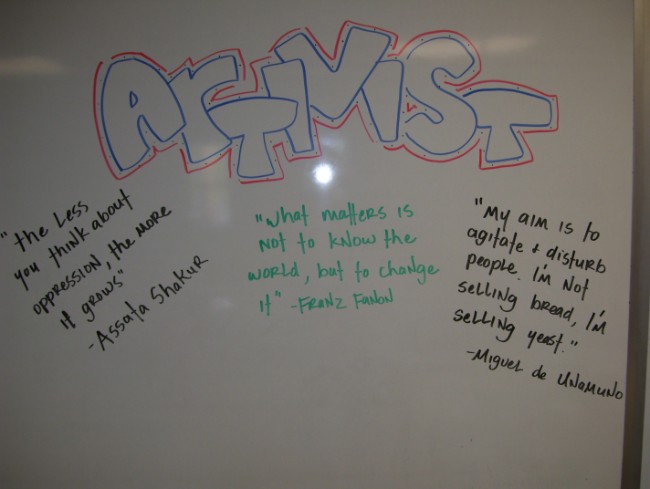
This was a week-long unit that I designed for the last week of my Student Teaching with just the two Honors classes. Throughout this week, we focused intensively on various social issues, research, and using writing to work for change. Using art to promote change, everyone in the class became "Artivists," as mentioned above (I had this written on the board when students came into the room for that day to introduce this project). To see sample student writing projects, see the "Student Work" page.
Goals:
· Make a connection between literature and social issues
· Find and research one specific social issue that is of concern either communally, nationally, or globally
· Use writing as a way to talk about social issues and work for change
NCSCoS:
· 1.02, 1.03, 2.01, 2.02, 2.03, 2.04, 3.01, 3.02, 3.03, 4.01, 4.02, 4.03, 5.01, 5.02, 5.03
Materials:
· Index cards with excerpts from Elie Wiesel’s Nobel Peace Prize speech (phrases, words)
· Daybooks
· Elie Wiesel’s Nobel Peace Prize speech
· Social issues powerpoint
· Mac Laptop carts (all week)
· Craft supplies (upon request)
Lessons:
For this entire week, we will be doing an intensive study of the use of writing for social action. Therefore, this week we will do not DGP or Classworks or vocabulary. To begin the week, I will introduce an activity called “Power Lines” that I learned about from the UNCC Writing Project Conference. Students will be lined up in two lines facing each other; each line of students will say a phrase that I will provide and the other line will answer. This will be done in three rounds:
Ø line 1: I want it.
o line 2: You can’t have it.
Ø line 1: I’m feelin’ that.
o line 2: That’s wassup.
Ø line 1 and 2: I am beautiful and powerful.
After doing this activity, I will lead a debriefing session where students will give feedback about how they felt during the activity. I will also prompt students towards the final result I have in mind (the first round shows power over something, the second round shows power with something, the third rounds shows power within). This activity is meant to empower students, to affirm that they have a voice and can be powerful.
We will then transition to study two authors who use their voices in powerful ways in order to enact change, Maya Angelou and Elie Wiesel. Starting off, we will look at a poem, Maya Angelou’s “Phenomenal Woman,” in which Angelou exposes some of the issues she faces as a woman and then uses her writing to promote female empowerment. After reading and discussing this poem, I will begin a pre-reading activity and give every student 2 index cards phrases and words from Elie Wiesel’s Nobel Peace Prize speech written on them. I will then put students into groups of 5 and have them make speculations, predictions, and inferences about the text based on what they have written on their cards. After students have written their responses in their daybooks, we will read Wiesel’s speech out loud together and discuss its context and content. If there is extra time, the class will get into a cipher and start a spirit read. After reading both of these authors and their works, we will discuss how Angelou and Wiesel expose social issues and use their writing to pose solutions.
Next, I will prompt students to open their daybooks to a clean page and write in response to a string of images (I will project these in a PowerPoint). This activity is designed to get students thinking about various social issues and will also work to deconstruct stereotypes and prejudices. The last slide of the PowerPoint will read: “Things that make you feel: angry, worried, sad, concerned.” Students will take a few seconds and brainstorm various things or issues. I will then prompt students to choose three issues that: are of general social interest to them or a group of people; they feel strongly about; are not personal; they feel able to convince others about; they would like to research further. For each of the three issues, students will use one word or phrase to describe:
Ø (1) WHAT are the social issues or problems?
Ø (2) WHY do they exist?
Ø (3) HOW can we change things?
I will model all of these brief activities with my own examples. For instance, (1) Racism (2) Ignorance (3) Understanding.
Part 1 (homework if not finished in class, due Tuesday): At least one page typed or two pages written with the following information:
· Students will choose that one issue they are most interested in, know the most about, or want to research more.
· Students will reflect—why did you choose this issue? Why are you concerned about it? Why does it exist? How can you make a difference?
· Discuss who the intended audience would be for this issue and what mode or form would be most effective. Students are expected to justify the form that they will use to present their information.
For the next two days, students will thoroughly research their issue, finding out more information concerning what the issue is, why it’s a problem, and what can be done about it. As they work, students will be compiling their sources in an annotated bibliography where they will justify every source they add to the list.
Part 2 (homework if not finished in class, due Wednesday by the end of class): Annotated Bibliograph. After getting their topics and research approved, students will spend the rest of the week writing and working on their final products. Students have a choice how they want to present their information and opinions for this final part. For example, students may feel that a formal research paper is the most effective form and thus will write that; or, students may believe that the most effective mode of presentation is making a podcast, writing a letter to a congressman, creating an informational pamphlet or brochure, etc. I will provide a list of possible choices, but students have the freedom to create their own medium as long as it is approved by me.
Part 3 (homework if not finished, due Friday by the end of class): Final written product, incorporating multiple sources, defining what the issue is, who it affects, why it exists, and how we can change it. Students are also expected to go through with their plans outside of class concerning the issue and solution they choose. For example, if a student chooses to write a letter to a congressman, then s/he will actually mail that letter to a congressman; if a student chooses to make an informational brochure raising awareness about the dangers of unprotected sex and STDs, then s/he will actually distribute those brochures and find public places to plant them.
